Applying AI to Process Optimization — A Delphi Study on Business Process Improvement Patterns
How must an established BPI metamodel be extended to accurately represent AI-supported improvement patterns in process execution? An expert-based Delphi study seeks answers.
Motivation
Artificial intelligence is fundamentally and permanently transforming the way organisations design and improve their processes. Machine learning, natural language processing and intelligent automation open up entirely new possibilities for identifying bottlenecks, supporting decisions and adaptively optimising workflows.
At the same time, practice is lacking structured, methodologically sound frameworks that precisely describe how AI technologies should be purposefully embedded into business processes. Existing Business Process Improvement (BPI) methods were developed before the AI era and barely account for AI-specific aspects such as transparency, degree of autonomy or data dependencies.
This gap is the starting point of the present work: How must an established BPI metamodel be extended so that it can accurately, comparably and practically represent AI-supported improvement patterns?
The Research
„Applying Artificial Intelligence to Process Optimization: A Delphi Study on Business Process Improvement Patterns"
Supervisors: Prof. Dr. Stefan Schönig & Leo Poss
The aim of the thesis is to develop and validate — through expert consensus — an AI-extended metamodel for Business Process Improvement Patterns (AI-BPI). The starting point is the BPI metamodel by Falk (2013) — "Patterns for Business Process Improvement — A First Approach" —, which is extended in this work by AI-specific dimensions.
The metamodel defines the building blocks of a BPI pattern — a proven template for improving a business process. Think of such a pattern as a structured recipe: it specifies which Problem it solves, in what Context it applies, what the Solution looks like in practice, and which Effect — such as cost reduction, time savings or quality improvement — can be expected. Each box in the diagram (e.g. "Solution", "Effect") is a so-called class — it represents a category of information that a complete improvement pattern must describe. In this thesis, the model is deliberately extended by AI-specific classes: What type of AI technology is used? What role does it take on within the process? How is it ensured that the AI solution remains trustworthy and controllable?
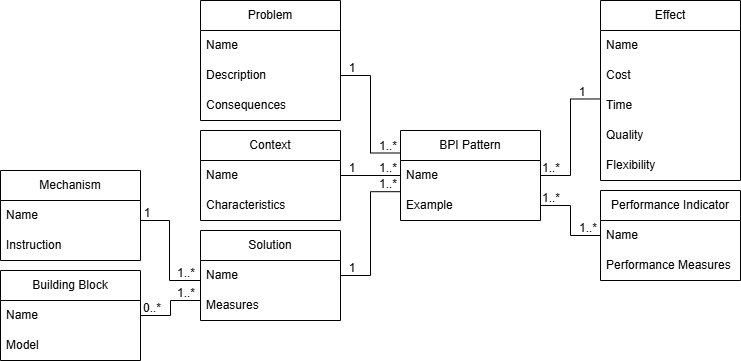
Figure: BPI metamodel by Falk (2013) — "Patterns for Business Process Improvement — A First Approach". Click to enlarge.
Business processes follow a six-phase BPM lifecycle — from identification and modelling through to monitoring and continuous improvement. The content focus of this work is on Phase 5 (Execution): the point at which processes are actually carried out and AI can be directly embedded within activities. The AI-BPI patterns developed here are tools of process improvement (Phase 6) — they describe in a structured way which AI technology can be deployed in Phase 5, and how, in order to achieve concrete improvements in cost, time or quality.
Relevant AI technologies in Phase 5 include machine learning for decision support, natural language processing for automated document handling, computer vision for visual quality control, large language models for intelligent process assistance, and robotic process automation (RPA) for rule-based automation. Practical use cases include intelligent routing of customer requests, automated credit decisions, predictive maintenance in manufacturing, real-time fraud detection, or AI-assisted review of incoming documents — all cases for which an AI-BPI pattern can provide a structured, reusable template.
Based on a preceding structured literature review, AI-specific class extensions were identified and formulated as initial proposals for the extended metamodel. These proposals form the evaluation basis of the Delphi study and are iteratively refined through expert feedback.
BPM lifecycle by Weske (2019). Phase 5 (Execution) is where AI is embedded within running process activities. The AI-BPI patterns of this study are applied in the context of Phase 6 to drive targeted improvements in Phase 5.
Value for Organisations
The validated metamodel provides organisations with a concrete orientation framework for the structured use of AI in business process improvement:
Embed AI purposefully into process activities
The metamodel precisely describes which AI services can be applied in which role within running process activities — including the technological and contextual prerequisites.
Transfer proven patterns to new contexts
Uniform classes and attributes allow validated AI-BPI patterns to be compared and reused across industries and contexts — rather than starting from scratch every time.
Capture governance aspects in a structured way
The extended metamodel aims to provide a foundation for representing security- and trust-relevant requirements of AI services — such as degree of autonomy or transparency — as an integral part of improvement patterns.
Evidence-based foundation for AI projects
A metamodel validated through expert consensus provides a practical basis for methodically evaluating and comparing AI deployment scenarios within business processes.
The Delphi Method
The Delphi method is a structured expert consultation procedure that iteratively builds consensus on complex issues over multiple rounds. Each round builds on the anonymously aggregated results of the previous one — until stability in the consensus is achieved. The study is designed to comprise four rounds in total.
The expert panel deliberately combines people from both academia and industry — to ensure that the metamodel is both theoretically grounded and practically relevant.
Phase 1 — Evaluating class extensions
AI-specific class extensions proposed on the basis of a structured literature review are evaluated by experts (Retain / Adapt / Drop). Experts are explicitly encouraged to propose additional classes. Responses are aggregated anonymously and carried into the next round until stable consensus on the final set of classes is reached.
Phase 2 — Defining attributes of finalised classes
In the second phase, the attributes of the agreed classes are developed and iteratively evaluated. Experts can again contribute their own attribute proposals. Rounds are repeated until stability in the consensus is achieved.
Outcome — Validated AI-BPI metamodel
The result is an expert-consensus-validated, AI-extended BPI metamodel that can serve as a foundation for practical AI-BPI patterns.
Participate
Participation in the Delphi study is open exclusively to invited experts. If you have received a personal invitation, it contains a direct link to register.